Animatronics vs. Static Props vs. Inflatables: Which Yard Decoration Fits Your Display?
Impact, setup, power, weather tolerance and storage compared across the three main types of Halloween yard decoration.
Affiliate disclosure: This guide contains links to Amazon. As an Amazon Associate we earn from qualifying purchases, at no extra cost to you. Recommendations are based on research, not hands-on testing, unless we say otherwise. How this works
Three kinds of decoration dominate Halloween yards: inflatables, static props such as skeletons and tombstones, and animatronics. Each has a different mix of impact, effort, weather tolerance and storage demands. The right choice depends less on taste than on your yard, your weather and your garage.
Quick answer
- Inflatables give the most size for the least storage space, and suit friendly, family displays.
- Static props are the most durable and flexible, and need no power.
- Animatronics deliver the biggest reaction, but most need shelter and careful storage.
- The strongest displays combine all three: static props for the scene, one animatronic for the scare, lighting to tie it together.
Head-to-head comparison
| Factor | Inflatables | Static props | Animatronics |
|---|---|---|---|
| Visual impact | Large and bright, visible from the street | Depends on staging and lighting | High, thanks to movement and sound |
| Mood | Usually playful | Anything from cute to grim | Usually scary |
| Setup | Stake, tether, plug in | Position and anchor | Assemble, power, aim the sensor |
| Power | Continuous, for the fan | None | Batteries or adapter |
| Weather | Made for outdoors, but vulnerable to wind | Generally tolerant when anchored | Most need to stay dry |
| Storage | Folds into a small box | Bulky, especially large skeletons | Large box, handle with care |
| Upkeep | Check tethers, patch small tears | Very little | Batteries, sensors, moving parts |
| Relative cost | Low to moderate for their size | Low to high, depending on scale | Moderate to high |
The cost row is a general comparison. Prices vary by size and season, so check current listings.
Inflatables
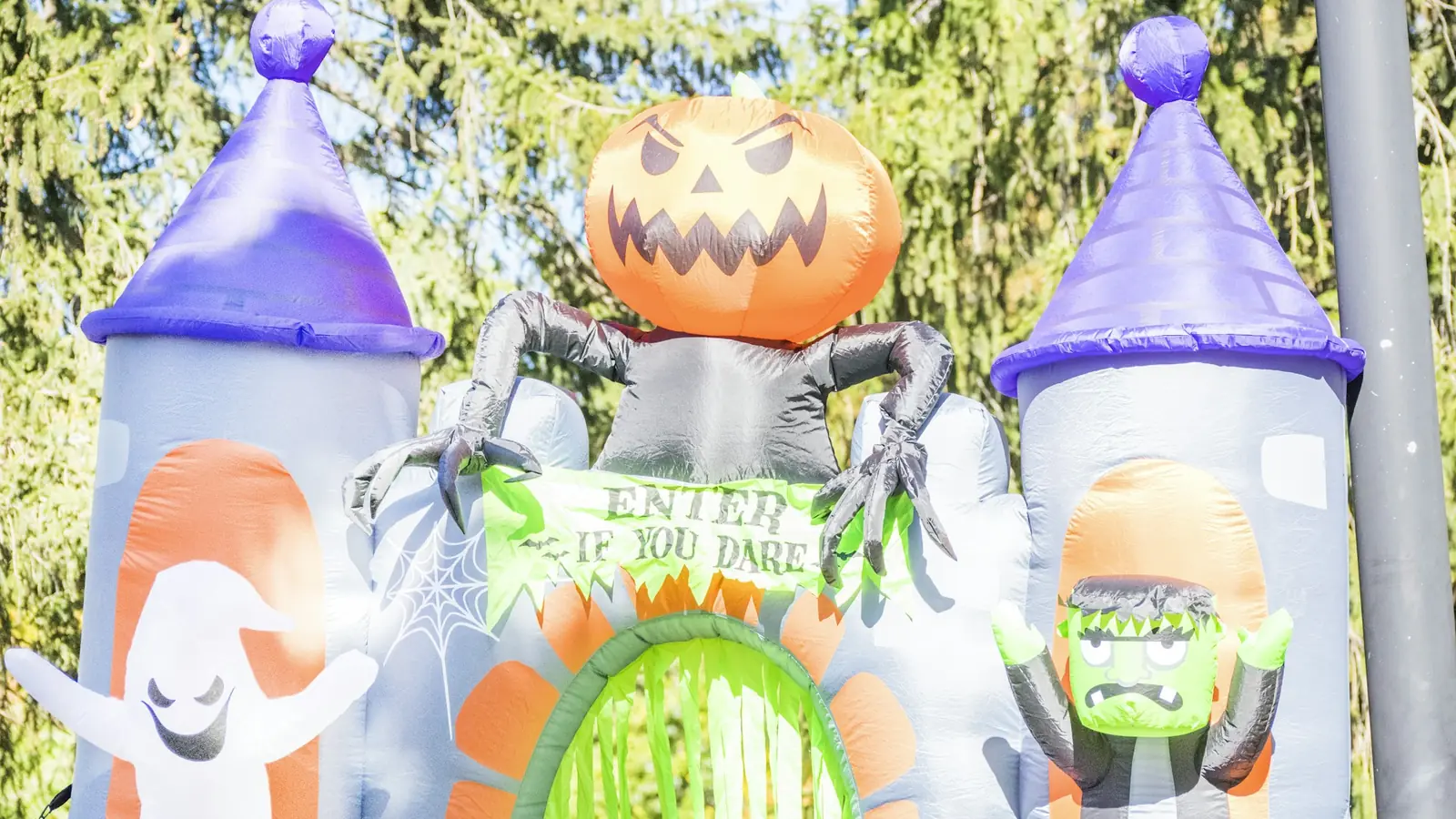
An inflatable is a fabric shell kept upright by a small fan that runs the whole time the display is on. That makes it quick to put up and take down, and easy to store. Most have internal lights, so they look good after dark with no extra work.
Where they struggle: wind. A tall inflatable acts like a sail, so use every tether point and deflate it in high winds or storms. The fan makes a steady hum, the display needs a fairly flat patch of ground, and a deflated inflatable looks like a puddle of fabric during the day unless you run it on a timer that matches when people are passing.
Static props
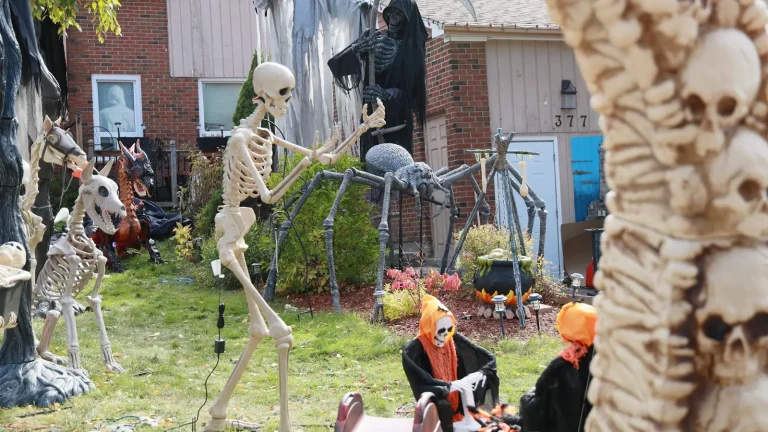
Skeletons, tombstones, fencing, spiders and similar pieces need no power and tolerate most weather. They are also the most flexible: the same skeleton can climb a roof one year and sit in a lawn chair the next. Because they do not move or light up, they rely on staging. A static scene with good lighting usually looks better than an expensive prop in the dark. Our outdoor lighting guide explains how.
Where they struggle: storage. Oversized skeletons and props take up serious garage space, and lightweight foam pieces blow away unless they are staked.
Animatronics
Movement and sound get reactions that nothing else matches, which is why a single animatronic often becomes the centrepiece of a display. They also ask the most of you: a power source, a well-aimed sensor, protection from rain and gentle handling in storage. Many are intended for indoor or covered use only. Our animatronics buying guide covers triggers, power and placement.
Which fits your situation?
- Small porch or apartment balcony: a few static props and string lights. Add a compact animatronic if the porch is covered.
- Family street with young trick-or-treaters: inflatables and friendly static props.
- Large, exposed, windy yard: staked static props and lighting. Use inflatables with caution.
- Covered porch or garage walk-through: animatronics, where they are sheltered and close to power.
- Very little storage: inflatables and flat or collapsible props.
- No outdoor outlet: static props with battery or solar lighting.
What to buy
Frequently asked questions
Do inflatables use a lot of electricity?
The fan runs continuously while the inflatable is up, but small blower motors draw modest power. Check the wattage on the product label and add it to your circuit total.
Can I leave an inflatable up in the rain?
Outdoor inflatables are made for ordinary wet weather, but follow the manufacturer’s instructions, keep the plug and connections dry, and deflate in storms or high winds.
What is the lowest-maintenance option?
Static props. Once anchored they need almost no attention until you pack them away.
How do I combine different types without it looking cluttered?
Pick one theme and one focal point. Use static props to build the scene, one moving or inflatable feature to draw the eye, and two or three lighting colours at most.